
Why Hygienists Hate Assisted Hygiene — And Why You Should Do It Anyway
Let's be honest about something most consultants who are recommending it won't say out loud: a lot of hygienists don't want to work in an assisted hygiene model.
I know, because I asked them.
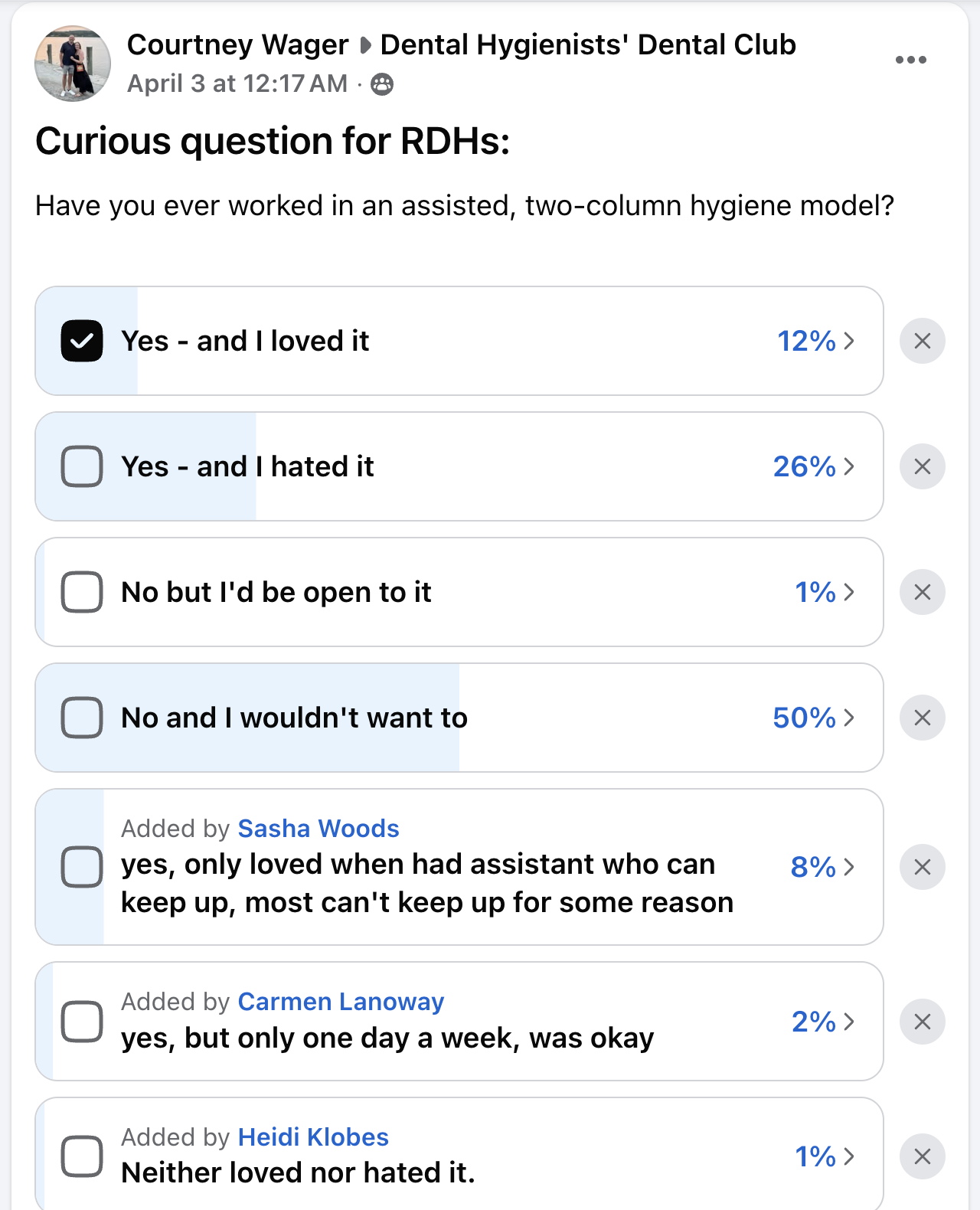
In a recent poll with 183 responses in a national hygienist Facebook group, 50% said they'd never worked in assisted hygiene — and wouldn't want to. Another 26% tried it and hated it. Only 12% loved it.
If you're a practice owner reading that, your first instinct might be to close this tab. If hygienists hate it, why would you even consider it?
Stay with me…
The hygiene shortage isn't going away — and the usual solutions aren't working
The ADA Health Policy Institute just published new data that should stop every practice owner in their tracks. Only 60% of dentists currently have an adequate number of hygienists on staff. Among dentists actively recruiting, 91% described it as very or extremely challenging to find candidates.
And here's the biggest challenge: what used to work no longer does. Hygiene program enrollment is actually up 16% since 2020. Graduate numbers are at an all-time high. Yet the total number of staff working in dental offices has been essentially flat for over a year.
More graduates. Same shortage. Something else is going on.
The ADA's own data points to wages failing to keep pace with inflation, margin compression making it hard for practices to compete, and a labor pool that simply isn't growing fast enough to meet demand. Their conclusion? If nothing changes, current staffing shortages are likely to persist.
So if hiring isn't the answer — or at least not the whole answer — what is?
Back to why hygienists hate it
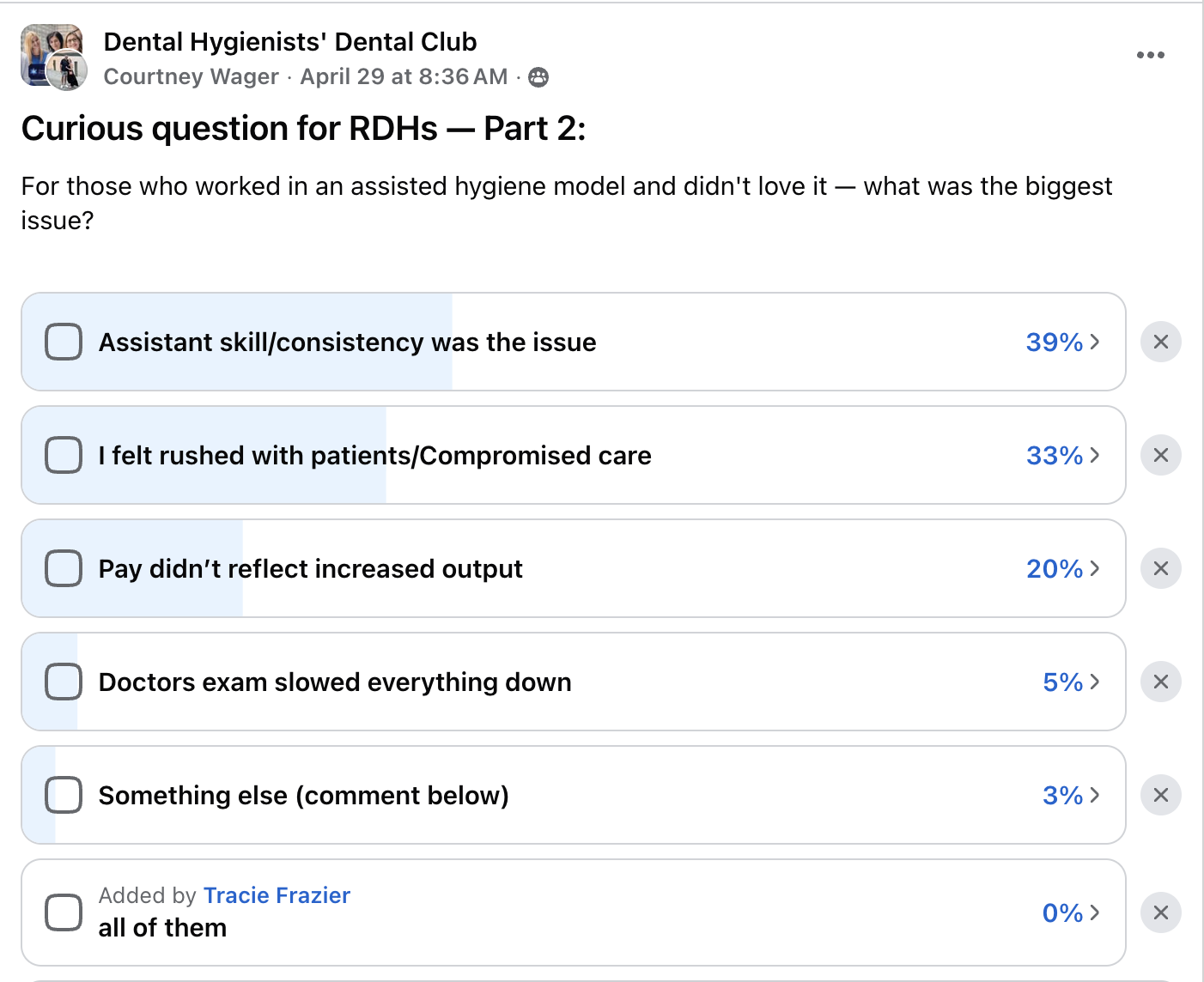
I didn't stop at the first poll. I asked a follow-up question: for those who worked in an assisted model and didn't love it, what was the biggest issue?
Here's what they said:
39% — the assistant wasn't skilled or consistent enough
33% — they felt rushed with patients, like care was being compromised
20% — their pay didn't reflect the increased output
Read that list again. Every single complaint describes a problem with how the model was set up — not with the model itself.
An undertrained assistant. No thoughtful workflow design. A compensation structure that didn't change when the workload did. A doctor exam flow that nobody planned for.
That's not assisted hygiene failing. That's implementation failing.
But the pieces have to be in place from the start. If your hygienist feels like they were thrown into the deep end on their own — even once — you're unlikely to get a second chance.
What it looks like when it's done right
I've worked in a two-column assisted hygiene model for my entire 20-year career. I've never felt rushed. I've never felt like I was compromising care. I consistently produce over $330 per clinical hour — and I genuinely love the way my days are structured.
The difference isn't the concept. It's everything that surrounds it.
The right assistant, properly trained and given a defined role. A schedule that's designed around optimal flow, not just the numbers. A compensation model that makes the hygienist feel like a partner in the outcome, not just someone being asked to do more. And a doctor exam integration that keeps things moving instead of grinding to a halt.
When those pieces are in place, the 12% who loved it starts to look a lot more like the norm.
So why should you do it anyway?
Because waiting for the hygienist shortage to resolve itself isn't a strategy. Because the practices that figure out how to do more with their existing team are going to be in a fundamentally different position than the ones still posting on Indeed in two years.
And because the hygienists who hate assisted hygiene — many of them have never seen it done right.
That's not a knock on them. It's an honest look at how rarely it gets implemented well.
The goal was never to ask the hygienist to do double the work. It's to remove the work that never required a hygienist.
Are you struggling to find a hygienist?
Get my guide on what to do when you can’t find a hygienist, and what you can do in the meantime. You can get the guide here.