
Updated November 8, 2026
Dentists: if you followed your hygienist through a one-hour recall appointment, how many of the tasks during that hour would actually require a hygienist?
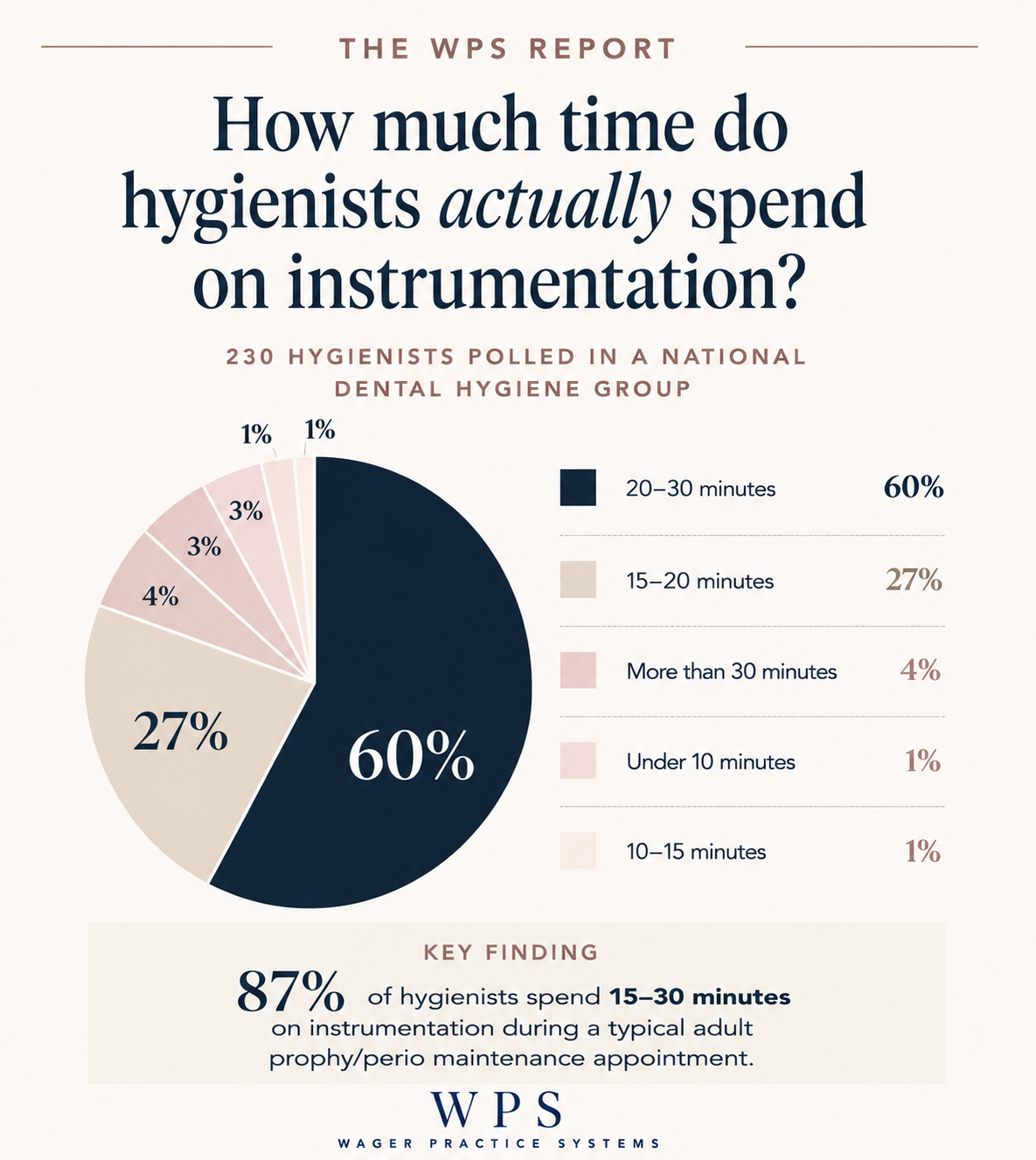
When I asked hygienists, 87% said only 15-30 minutes of their appointments goes to scaling.
Now, I’m a hygienist, so I’m well aware that scaling isn’t all we do, of course. Many parts of the appointment require a hygienist including the medical history, perio charting, airway and oral cancer screenings, and patient education. But even with all of that, a good part of the hour still goes to work that doesn’t.
So where does the rest of the time go? A lot of every recall hour goes to seating the patient, taking X-rays, polishing, turning over the room, instruments and sterilization, and waiting for the doctor’s exam. Outside of scaling part of an appointment, 80% of hygienists said the doctor’s exam takes the most time (WPS Report poll · 191 hygienists). I wrote about what that costs your schedule here.
That means you’re paying hygiene wages for work that doesn’t need a hygienist.
This isn’t a criticism of hygienists. Ask your hygienist and you’ll probably hear they need more time, not less. That’s because the hour was built for the hygienist to do everything. It’s how hygiene has always been scheduled, and most practices have never considered doing it differently.
It’s harder than ever to find hygienists, and hygienist wages are higher than they’ve ever been. Isn’t it worth considering a different way to run the hour, as long as it doesn’t burn out your team or lower the quality of care your patients receive?
The same hour, two ways
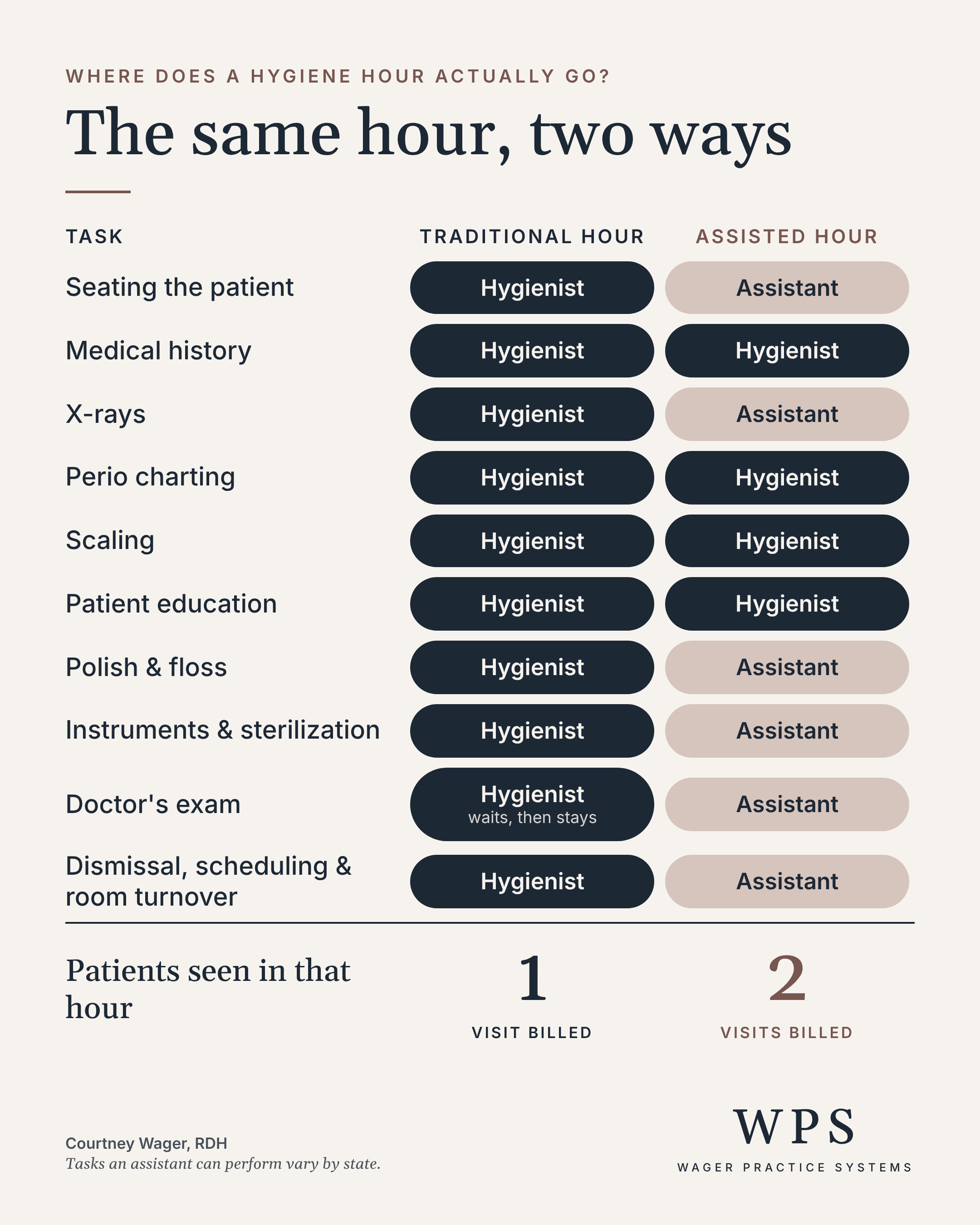
I’ve practiced assisted hygiene for 20 years. The graphic at the top of this post shows my hour next to a traditional one.
In a traditional hour, the hygienist sees one patient.
In mine, I spend about 30 minutes with each patient on the parts that need my education and clinical judgment: the medical history, assessment, perio charting, scaling, and talking with the patient about what I’m seeing. While my assistant polishes, stays with the doctor for the exam, dismisses the patient and turns over the room, I’m already in the next operatory with my second patient.
Same hour. Same hygienist. Two patients. And it isn’t rushed care: the time follows what each patient needs. I’ve cared for many of my patients for two decades. I have incredible rapport with them, and I’ve never burned out.
That’s the difference between assisted and accelerated hygiene. Accelerated means faster. Assisted means supported.
It’s not an assembly line, either. My assistant and I adjust to each other all day. If she’s behind, I take the X-rays. If I need a hand, she’s there.
Which tasks an assistant can perform depends on your state, so the split in your office may look different from mine.
The quality of care we provide isn’t determined by the time on the schedule.
It’s determined by what we do with that time.
I offer Hygiene Assessments for practices that want an outside look at where their hygiene time is going.
Not ready for that yet? Start with my free worksheet: Where Does Your Hygiene Hour Go? Fill it in with your own numbers to see how much of the appointment doesn’t require a hygienist, how many more patients a day that could mean, and what it’s worth. Get the Worksheet