
When the Hygienist Says There's Not Enough Time — But Also Needs an Hour Per Patient
If you’ve heard both of those things from your hygienist, you’re not alone. And they shouldn’t both be true.
So why are they? If you haven’t read it yet, I broke down where a hygiene hour actually goes in detail: where does a hygiene hour actually go?
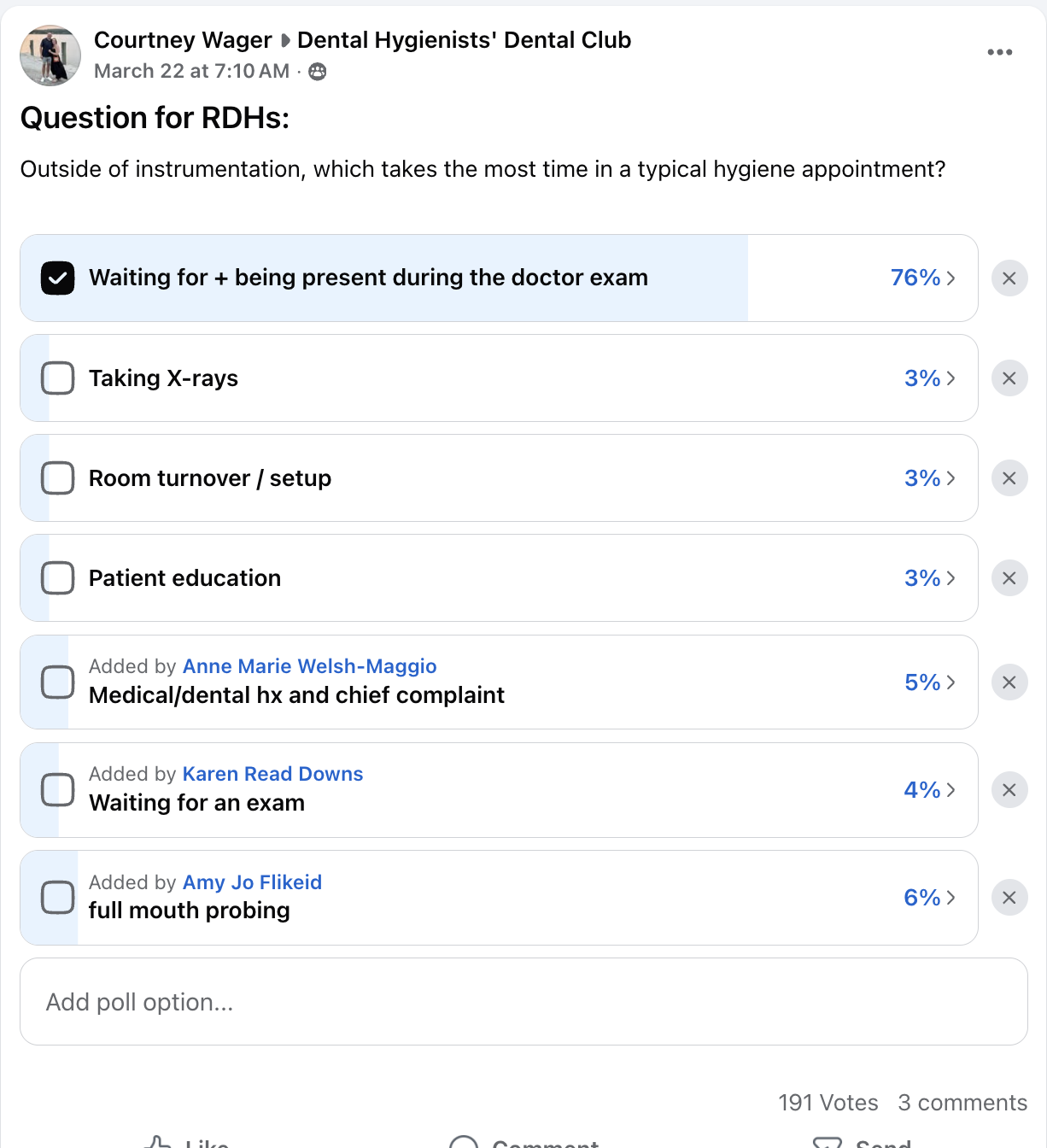
I’ve been polling hygienists in a national Facebook group of over 16,000 clinicians to understand where appointment time actually goes. In a recent poll of 191 responses, 80% said the same thing:
After instrumentation, the biggest time loss is waiting for and being present during the doctor exam.
The exam is necessary—for the patient and for the practice. But it does not require a hygienist.
Right now, one of your highest-value clinical providers is spending part of every hour waiting.
Not producing. Not assessing. Not moving the schedule forward.
Just waiting.
This isn’t a time problem, it’s a structure problem.
If your hygienist were seeing the next patient during that window—while an assistant supports the exam—you’re no longer limited to a single column. You’re running two.
No additional hygienist.
No increase in clinical load.
No burnout.
That’s what a properly structured assisted hygiene model allows.
I’ve practiced this way for 20 years at a high production level. It works because the structure works.
If this resonates with you, schedule a 20-minute call to see what this could look like in your practice.